Hypergamy
A social science term for marrying or dating up.

YitzhakNat · CC0
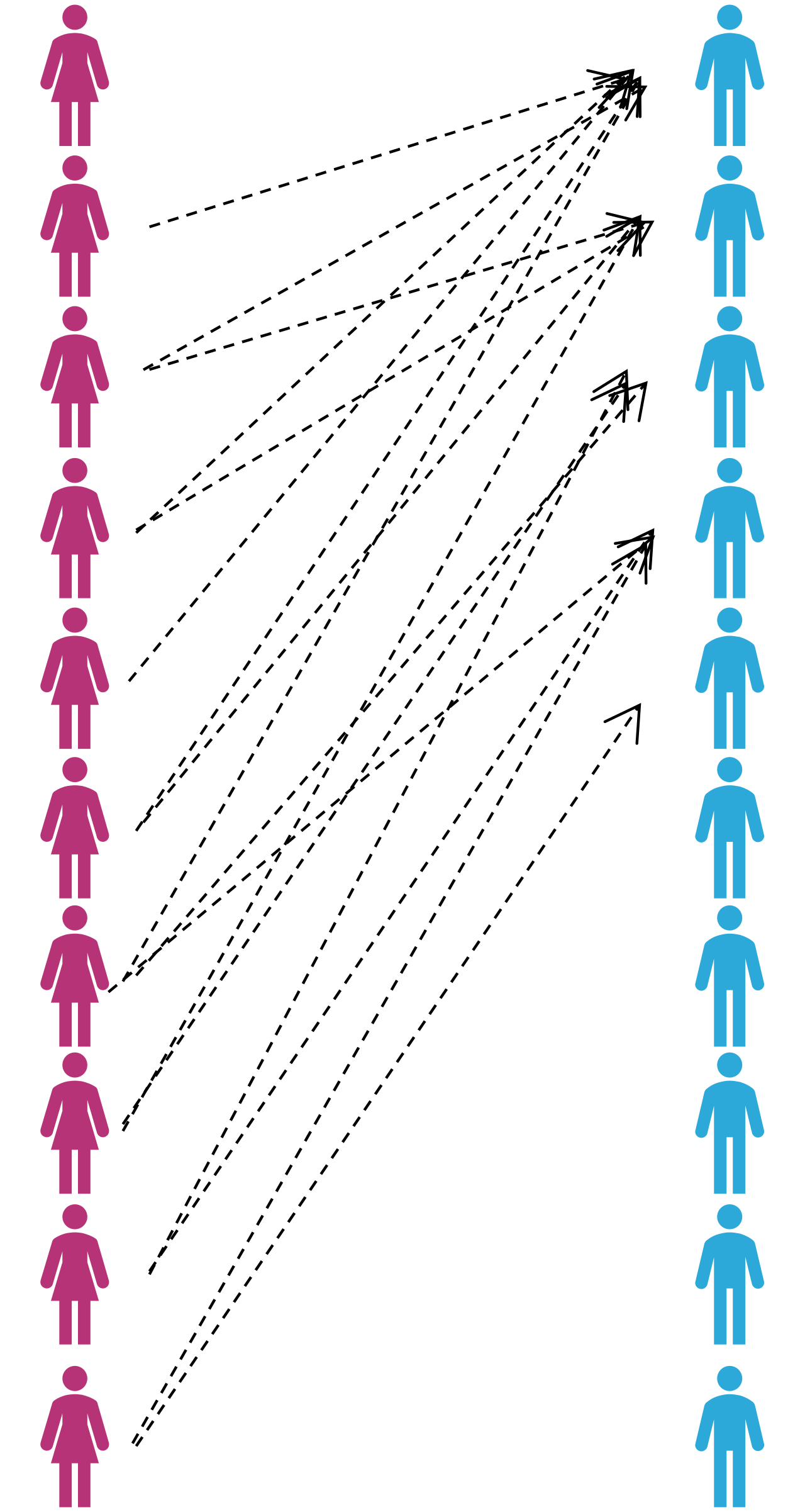
Hypergamy is a term used in social science for the act or practice of a person dating or marrying a spouse perceived to be of higher 'mating value' than themselves. Its definition has expanded over time from its past, more narrow sense. The antonym 'hypogamy' refers to the inverse: marrying a person perceived to be of lower 'mating value' (colloquially 'marrying down'). The term hypergyny can also be used to describe the practice of women marrying up. Concepts such as hypergamy, hypogamy, and hypergyny could be considered special cases of mésalliance.
- field
- Social science
- known_for
- Describing the practice of marrying or dating a spouse of higher perceived mating value
- related_terms
- Hypogamy, hypergyny, mésalliance
Lore & Background
References to Hindu law books from the Indian subcontinent in the 19th century include the Sanskrit terms anuloma and pratiloma, respectively, for the concepts of hypergamy and hypogamy. The early Christian Church, through voices such as St. Basil the Great, sought to limit the effects of hypergamous customs, notably the large age gap that may have resulted from hypergamous mate selection. This guideline was not a part of church canon but some orthodox or Coptic churches recommend respective gaps of around 4–8 years or 1–15 years, with narrower age gaps recommended for younger couples. In some incel and manosphere circles, hypergamy has been invoked to explain the belief that women disproportionately prefer socially dominant or conventionally attractive men.
Reader's Guide
Hypergamy has evolved from a classical macro-level structural practice—where an individual (typically a woman) marries a spouse of higher formal social caste, socioeconomic class, or educational attainment—to a modern multi-dimensional concept. Demographic research indicates that as female educational attainment and workforce participation surpassed men's in many developed nations during the late 20th and early 21st centuries, structural educational hypergamy declined significantly, shifting toward assortative mating (educational homogamy). Modern social science broadens hypergamy to encompass multi-dimensional 'mate value' trade-offs, including compensatory financial transfers, immigration benefits, and physical attractiveness. Quantitative data from online dating platforms suggests a significant skew in how attractiveness is appraised, with women rating approximately 80% of men as 'below average' in physical appeal. Research into the intersection of race and physical attractiveness highlights the persistence of specific demographic preferences, with white men often receiving a disproportionate amount of interest. Studies of mate selection in dozens of countries have found men and women report prioritizing different traits, with men tending to prefer women who are young while women tend to prefer men who are rich, in high social standing or physically attractive. The more gender-equal a country, the likelier male and female respondents were to report seeking the same qualities in each other.
Did You Know?
- The Sanskrit terms anuloma and pratiloma refer to hypergamy and hypogamy, respectively, in 19th-century Hindu law books.
- St. Basil the Great sought to limit large age gaps resulting from hypergamous customs, though this was not church canon.
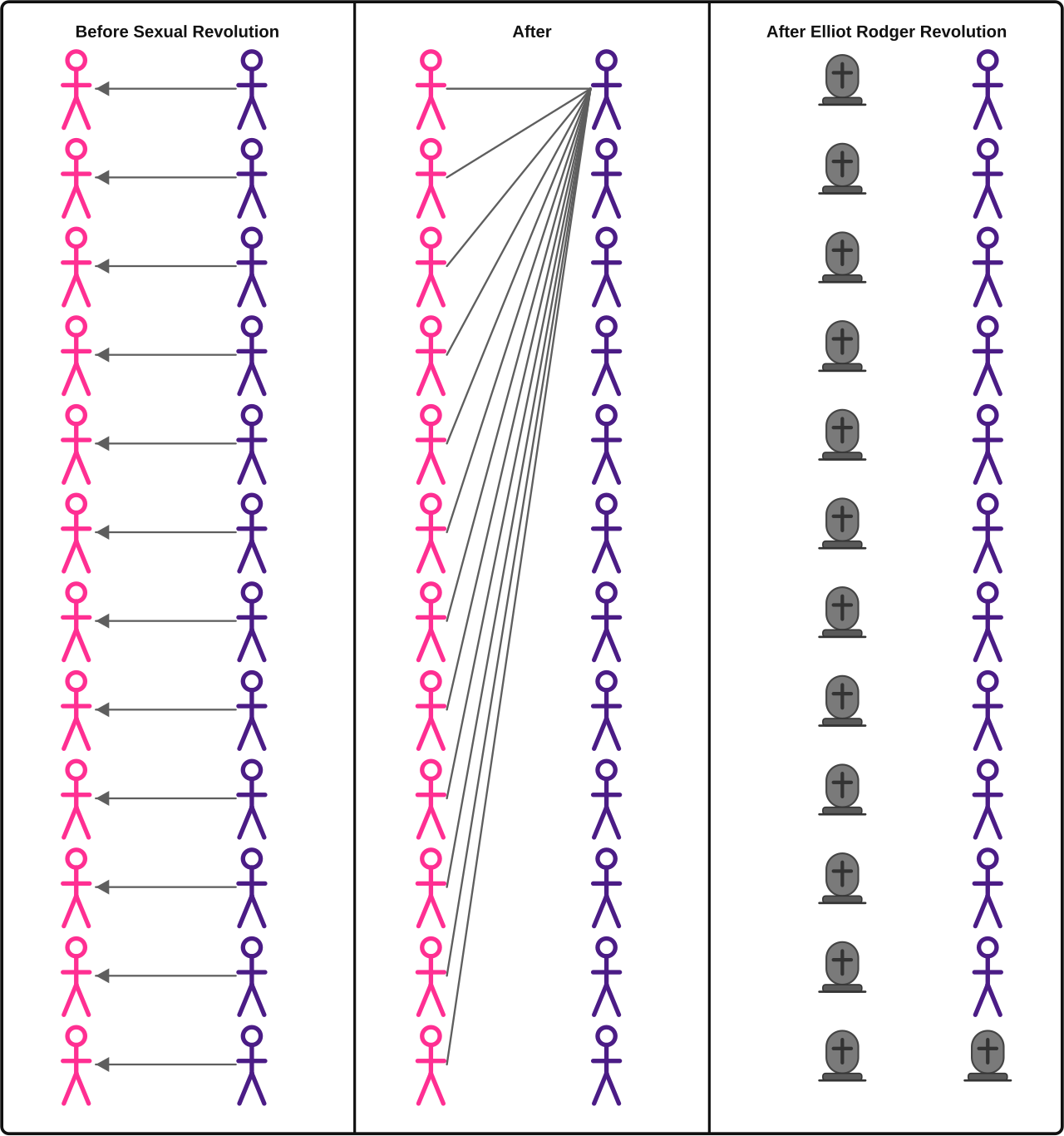
- Elliot Rodger's diagram about female hypergamy was described as an adaptation of a manosphere meme.
- OkCupid data indicated that women rated approximately 80% of men as 'below average' in physical appeal.
Historical and Religious Roots
The concept of pairing with a partner perceived as socially superior is far older than modern social science. Nineteenth-century Hindu legal texts from the Indian subcontinent already drew a clear linguistic distinction using Sanskrit vocabulary: anuloma described the practice of marrying upward, while pratiloma captured its inverse, marrying downward. These terms predate Western academic framing by centuries. In the Christian tradition, the early Church also grappled with the social consequences of upward marriage. St. Basil the Great and other voices urged limits on hypergamous customs, particularly the wide age disparities that could emerge when a younger woman paired with a considerably older, higher-status man. Although this guidance never entered formal church canon, it left a lasting imprint on certain traditions. Orthodox and Coptic communities, for instance, have historically recommended age gaps ranging from roughly four to eight years, or in some cases one to fifteen years, with narrower ranges suggested when the younger partner is still quite young. These early institutional responses reveal that concerns about the social and relational effects of status-driven mate selection have deep theological and legal roots.
From Structural Practice to Multi-Dimensional Exchange
For much of the twentieth century, anthropologists and sociologists defined hypergamy in narrow structural terms: a woman formally marrying into a higher caste, a wealthier class, or a more educated social stratum. Demographic data now shows that as women's college enrollment and labor-force participation outpaced men's across many developed countries in the late 1990s and 2000s, this kind of educational hypergamy eroded considerably. Population-level mating patterns shifted toward what researchers call assortative mating, where partners tend to match in education and income. Yet modern social science, drawing on evolutionary psychology and the economic frameworks pioneered by Gary Becker, argues that hypergamous dynamics did not vanish. They simply migrated into less visible compensatory exchanges. A couple who are educational peers may still display functional hypergamy when one partner consistently shoulders greater financial provisioning, or when youth and physical appeal are quietly traded for earning capacity and social standing. In cross-border marriages, the pattern can take an even more concrete form: a younger, attractive partner may exchange those attributes for permanent residency or citizenship, with women disproportionately occupying the receiving side of such legal arrangements. In short, formal structural hypergamy has thinned, but multi-dimensional mate-value trade-offs persist within the dating market.
Attractiveness, Data, and the Digital Dating Landscape
The rise of large-scale online dating platforms has given researchers an unprecedented window into how physical attractiveness functions as a hypergamic criterion. Data released by OkCupid revealed a striking asymmetry: men tended to spread their ratings across a roughly bell-shaped curve, while women rated approximately eighty percent of male profiles as below average in physical appeal. This quantitative skew has become a central reference point in discussions of mate-value selectivity. Racial dynamics add another layer. Studies in journals such as Psychological Science and various sociological reviews have documented that, in Western dating markets, white men frequently receive a disproportionate share of positive signals and higher attractiveness scores relative to men of other ethnic backgrounds. Sociologists often attribute this to what they call sexual racism or racialized erotic capital, arguing that Eurocentric beauty norms inflate the perceived desirability of certain groups. The practical outcome, as data-driven analyses suggest, is that the most attractive white men tend to occupy the top tier of the digital dating hierarchy, drawing the highest volume of interest from a broad cross-section of female users. Researchers read this as a convergence of hypergamic preference and pre-existing social hierarchies.
Hypergamy in Controversial Modern Discourse
Hypergamy has become a flashpoint in online male-dominated communities, particularly within incel and broader manosphere circles, where the concept is invoked to explain a perceived pattern: that women disproportionately gravitate toward socially dominant or conventionally attractive men. One notable example emerged before the 2014 Isla Vista attacks. Elliot Rodger posted a multi-panel diagram depicting women systematically abandoning the majority of men in favor of a small elite of highly desirable partners. The final panel portrayed the rejected men as dead, following what the image framed as a violent revolution. David Futrelle, writing for the feminist site We Hunted the Mammoth, described the diagram as Rodger's adaptation of a manosphere meme centered on supposed female hypergamy. Rodger's written manifesto echoed the same logic, asserting that attractive women chose what he called brutal men over those he considered more deserving, and he pinned his personal rejection squarely on women's freedom to select sexual partners. The episode illustrates how a social-science term can be repurposed in online discourse to frame mate selection as a zero-sum hierarchy, fueling resentment rather than analytical understanding.
Gallery
Frequently Asked Questions
What is Hypergamy in the context of marriage and kinship?
Hypergamy is a social-science label for the pattern in which someone chooses a partner they perceive as having greater overall 'mating value' than themselves. The term has broadened over time beyond its originally narrower definition to cover dating as well as marriage.
What is the direct opposite of Hypergamy?
The antonym is hypogamy, which describes the inverse situation of pairing with someone perceived to hold lower mating value. In everyday language this is often shortened to 'marrying down.'
How does Hypergamy differ from Hypergyny?
Hypergyny is a gender-specific subset that refers only to women choosing partners of higher perceived value. Hypergamy, by contrast, is the umbrella term that can apply to any individual regardless of gender.
Which academic field does Hypergamy belong to?
It sits squarely within social science, particularly in the sub-fields studying marriage, kinship, and partner selection. It is typically discussed alongside related concepts such as hypogamy, hypergyny, and mésalliance.
How does Hypergamy connect to the broader idea of mésalliance?
Scholars often treat hypergamy, hypogamy, and hypergyny as particular sub-types of the wider category of mésalliance, which covers any union perceived as a mismatch in social or economic standing. In that framing, hypergamy simply marks the 'upward' direction of the mismatch.
More in Marriage And Kinship 1-18
Spotted an error? Know more?
This is a living reference — every entry is fact-audited, and reader corrections feed straight into our audit queue. Suggest an edit · See this site's audit record