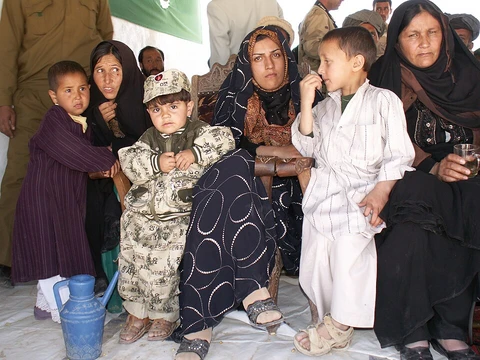
Godparent
Christian sponsor for a child's baptism and spiritual guidance.

U. A. Saarinen · CC BY 4.0
A godparent, also known as a sponsor, is a person chosen by a child's parents to bear witness to the child's baptism and to assist in the child's catechesis and lifelong spiritual formation. Within Christianity, a male godparent is called a godfather and a female godparent a godmother; the child is referred to as a godchild. The role has both religious and civil dimensions, involving an interest in the child's upbringing and personal development.
- field
- Christian religious practice
- known_for
- Witnessing baptism and mentoring the godchild's spiritual growth
- earliest_mention
- 2nd century AD
- key_development
- Replacement of birth parents as sponsors by the 5th–6th centuries
Lore & Background
As early as the 2nd century AD, infant baptism gained acceptance among Christians, and sponsors were normally the birth parents. St. Within a century, the Corpus Juris Civilis indicates that parents had been almost completely replaced by non-parents as sponsors. By the 5th century, male sponsors were called 'spiritual fathers,' and by the end of the 6th century, they were referred to as 'compater' and 'commater,' meaning spiritual co-parents.
Reader's Guide
The institution of godparenthood created a network of spiritual kinship that extended beyond natural family ties. The Council of Trent later limited these marriage barriers to relationships between godparents, the child, and the parents. During the Reformation, Luther, Zwingli, and Calvin preserved infant baptism and sponsors, though with differing views: Luther opposed marriage prohibitions, Zwingli emphasized parents and pastors, and Calvin preferred birth parents as sponsors. Some Calvinist traditions, notably in Scotland and English colonies, eliminated godparents entirely. In 14th-century Spain, as many as 20 godparents were chosen for a single child. The Council of Trent attempted to limit numbers to one or two, but practice differed across the Catholic world. Modern Anglican, Lutheran, Methodist, Orthodox, and Reformed churches each have distinct requirements and customs regarding godparents, including qualifications of baptism and confirmation, and the role of sponsors in the child's Christian upbringing.
Did You Know?
- In early 14th-century Spain, as many as 20 godparents were chosen for a single child.
- The Council of Trent limited marriage barriers to relationships between godparents, the child, and the parents.
From Birth Parents to Spiritual Co-Parents
The practice of naming a godparent for a baptized child traces back to the second century, when infant baptism began to be widely accepted among Christians as a means of spiritual purification and social initiation. In those earliest days, the sponsors were typically the child's own birth parents. This arrangement persisted until around 408, when St. Augustine noted that other individuals could serve in this capacity under exceptional circumstances. Within roughly a century, legal texts such as the Corpus Juris Civilis reveal that non-parents had almost entirely supplanted biological parents in this role. The shift was made explicit in 813, when the Synod of Mainz formally barred natural parents from acting as godparents to their own offspring. The language used to describe these sponsors evolved alongside the practice: by the fifth century, male sponsors were called "spiritual fathers," and by the close of the sixth century, the terms "compaters" and "commaters" had taken hold, framing the relationship as one of spiritual co-parentage rather than mere religious obligation.
Marriage Bars and the Web of Social Protection
As the godparent role became distinct from biological parenthood, civil and religious law increasingly treated the spiritual bond as carrying the same weight as blood kinship. A decree issued by Emperor Justinian in 530 explicitly forbade a godfather from marrying his goddaughter, and over the following centuries these prohibitions multiplied, extending to natural parents, spiritual parents, and their direct relatives until the eleventh century. When confirmation separated from baptism as a distinct rite in the eighth century, a second tier of sponsors emerged, each carrying its own set of marriage restrictions. The precise boundaries of these spiritual impediments in Catholic canon law remained murky until the Council of Trent drew a clearer line, restricting the bar to relationships among godparents, the child, and the parents. Beyond legal formalism, historian John Bossy has argued that in the fractious world of the Middle Ages, baptismal sponsorship functioned as a powerful social instrument: it transcended narrow kinship alliances and wove broader networks of mutual protection, support, and friendship, effectively disarming hostility and fostering unity in communities riven by feuding.
The Reformation and the Question of How Many
When the Protestant Reformation swept through Europe, the major reformers—Luther, Zwingli, and Calvin—chose to retain infant baptism and its accompanying sponsors, even as radical Anabaptists rejected the practice outright. Yet their visions of what a godparent should do diverged sharply from Catholic norms. Luther rejected the marriage prohibition between godparents and godchildren. Zwingli shifted emphasis toward the responsibilities of parents and pastors. Calvin preferred that birth parents themselves serve as sponsors. In practice, these theological differences produced wildly different customs: French Calvinists in Geneva settled on a single godparent, while Calvinists in Scotland and the English American colonies abandoned the institution entirely. The number of sponsors also varied enormously across time and place. The early church typically used one; the early Middle Ages favored two, one of each sex, a pattern still observed in Orthodox Christianity. The Council of Metz in 888 tried to cap the number at one, but the rule was largely ignored. In early fourteenth-century Spain, a single child could have as many as twenty godparents. England's Synod of Worcester in 1240 settled on three—two of one sex and one of the other—and that arrangement endures in the Church of England to this day.
Anglican Turbulence and Lutheran Continuity
The Church of England's relationship with godparents has been anything but stable. Although the Anglican Communion's mother church retained the practice and formally dismantled the marriage barriers in 1540, the institution was abruptly abolished in 1644 when the Civil War-era Parliamentary regime issued its Directory of Public Worship. Even then, some parishes in northern England quietly continued the custom. After the 1660 Restoration, godparents were reinstated, though with occasional objections, and nearly every dissenting church dropped them. Evidence suggests the restored institution had already shed some of its former social weight and universality. Today, the Church of England permits relatives to serve as godparents, and while parents are not clearly eligible, they sometimes do. Godparents are expected to be both baptized and confirmed, though the confirmation requirement can be waived, and individual clergy retain considerable discretion over qualifications. In contemporary Anglican rites, parents and godparents alike are called to respond on behalf of the infant candidate. Lutheran churches, by contrast, have maintained a theology closely aligned with the Catholic tradition, holding that godparents assist a child's Christian formation, particularly in the event of losing their parents, and likewise require sponsors to be both baptized and confirmed Christians.
Gallery


Frequently Asked Questions
Who is a Godparent in the context of marriage and kinship?
A godparent is a person chosen by a child's parents to witness the child's baptism and to help guide the child's spiritual education over a lifetime. The role carries both a religious dimension and a broader interest in the child's personal development.
What are the core responsibilities of a Godparent?
The primary duty is to bear witness at the baptism ceremony and to support the child's catechesis and ongoing spiritual formation. Beyond the strictly religious function, a godparent also takes an active interest in the child's upbringing and personal growth.
When does the Godparent tradition first appear in history?
The earliest references to this role trace back to the 2nd century AD within Christian religious practice. It gradually developed into a more formalized institution over the following centuries.
What is the difference between a godfather, godmother, and godchild?
In Christian usage, a male sponsor is called a godfather and a female sponsor a godmother, while the child they are sponsoring is referred to as the godchild. These terms simply reflect the gender of the sponsor and the relational position of the child.
How did the Godparent role change by the 5th–6th centuries?
A key shift occurred when the practice moved away from having the child's birth parents act as sponsors at baptism. By the 5th and 6th centuries, the role had become one filled by a separate, deliberately chosen individual rather than a parent.
More in Marriage And Kinship 1-18
Spotted an error? Know more?
This is a living reference — every entry is fact-audited, and reader corrections feed straight into our audit queue. Suggest an edit · See this site's audit record